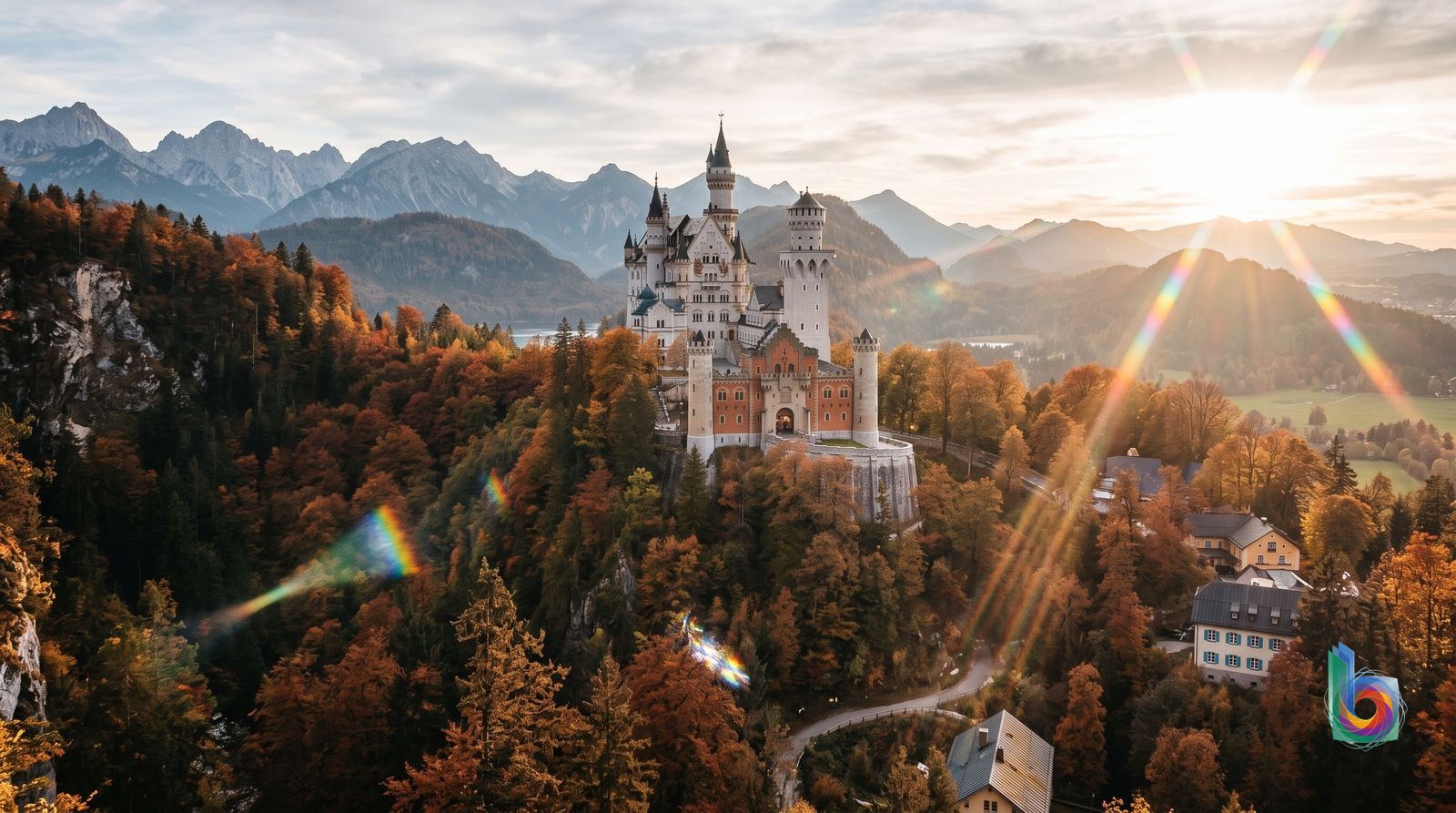
Season by season
Late May to June
Longer walking days and usually mild conditions make this one of the most balanced periods for castles, lakes and town walks.
Weather remains changeable in the Alpine foothills, and weekends and school-holiday periods can still be busy.
July to August
Warmest weather and fullest daylight, but also the heaviest Neuschwanstein crowds, packed buses and frequent afternoon rain risk.
Book castle tickets first and expect queues, crowded approaches and higher demand for rooms; warm weather is not a guarantee of clear mountain views.
September to early October
Often mild with good walking light and less intense pressure than high summer, making it another strong all-round choice.
Conditions can turn cool or wet quickly, and autumn visibility is variable.
November to March
Winter can be scenic and quiet in town, but daylight is short and snow or ice can affect paths and mountain viewpoints.
Verify conditions before planning Mary’s bridge, Tegelberg or any hike; access disruptions are possible and the classic exterior-view itinerary is less dependable.
Events worth planning around
Bavarian and wider European school-holiday periods · Usually summer, Easter and other variable holiday weeks
These periods materially increase castle-ticket demand, bus crowding and accommodation pressure; book official castle times and lodging earlier than usual.
Getting around
Walking
Füssen Old Town, the station-to-centre walk, and short scenic extensions such as Lechfall.
Base yourself centrally and explore the Altstadt on foot; use walking as the default within town.
Castle country is not a casual walk from central Füssen, and uphill approaches, wet paths and winter ice require shoes with grip.
Regional train
Arriving from Munich or using Füssen as a rail base.
Füssen station is an easy walk from Old Town; direct Munich regional trains run roughly every two hours, while other connections commonly change around Buchloe.
A Munich airport arrival plus train transfer is a three-and-a-quarter-to-four-hour proposition, not a painless same-day castle dash.
Buses 73 and 78
The car-free connection between Füssen station and Hohenschwangau/Neuschwanstein.
Take the castle bus from the station area, then allow time to walk uphill or use the shuttle when it operates; ask your accommodation whether a local guest card covers local buses.
Peak-season buses are crowded, and a bus ride does not remove the need for a timed castle ticket or a walking/security buffer.
Castle shuttle and horse carriages
Reducing part of the uphill effort near Neuschwanstein when operating and appropriate for your mobility needs.
Treat them as optional last-leg transport rather than the core plan, and still leave time to reach the entrance.
Shuttle operations and queues are variable; horse carriages are not efficient public transport.
Car or taxi
Scattered trailheads, lake villages, Linderhof or Wieskirche, especially beyond a short first visit.
A car is useful for the wider region; taxis are best kept as a backup for a specific journey.
At Hohenschwangau, a car often adds parking stress in peak season, while taxis and app-based rideshare are limited compared with a city.
Safety: Füssen is generally calm; the practical risks are slippery or restricted mountain and lakeside paths, so check conditions for Mary’s bridge and hikes, wear grip-soled shoes, and carry ID if crossing into nearby Austria.
Book before you land
Neuschwanstein Castle: book the official timed guided-tour ticket before arrival—at least a month ahead in high season is prudent, and popular dates can go sooner. Same-day tickets commonly disappear by late morning. · Hohenschwangau Castle: reserve ahead too if it matters to you, especially when pairing it with Neuschwanstein on the same day. Do not assume an unsold Neuschwanstein slot will line up with it. · Do not pre-buy a generic ‘skip-the-line’ transport tour merely to solve a ticket problem; use the official Hohenschwangau ticket system first.
- Stay in Füssen or Hohenschwangau the night before a castle visit if the ticket time matters. Trying to fly into Munich and do the castle as a same-day side trip turns a short tour into a transport-heavy gamble.
- Carry a payment card and some cash. Small purchases and rural service businesses can still be less card-friendly than visitors expect.
- Use only official castle tickets. At Neuschwanstein, photography is prohibited inside, and a ticket does not eliminate the uphill walk, shuttle queue or security buffer.
- Wear shoes with grip, not fashion sneakers, for the castle approach, Kalvarienberg and lake paths; weather changes quickly around the foothills.
- Marienbrücke is free but access can be restricted for weather, ice, maintenance or crowd control. Treat the classic exterior view as a bonus, not the only reason to visit.
- Austria is one kilometre away in places. Carry identification if crossing the border, and do not assume German local tickets or mobile coverage arrangements work seamlessly across it.
Worth leaving the city for
Hohenschwangau and Neuschwanstein castlesHalf day for one castle; a full, carefully timed day for both plus the uphill walk and Marienbrücke.
This is the essential outing, and it is close enough that it should be treated as Füssen’s second centre rather than a grand expedition. Hohenschwangau provides the historical counterweight to Neuschwanstein’s theatrical fantasy; doing both is worthwhile only if you actually want two interiors.
Linderhof PalaceFull day by public transport; roughly a long half day only with a car or a well-matched tour.
Ludwig II’s only completed palace is the better choice for travellers who prefer a finished, inhabited-feeling royal interior to another exterior photo stop. It is sufficiently different from Neuschwanstein to justify the travel.
Wieskirche, SteingadenHalf day, but public buses are limited—check the return before leaving Füssen.
A UNESCO-listed Rococo pilgrimage church of exceptional quality, not a filler stop. It makes more sense than forcing a second castle if you care about art and architecture.
TegelbergHalf day for the cable car and viewpoints; a full day if hiking.
Go for the big Alpine panorama, hiking and the mountain-railway experience rather than another palace queue. It is the strongest nearby choice on a clear day.
Ehrenberg Castle ruins and Reutte, TirolHalf day by car; allow most of a day by public transport and on-foot exploration.
Across the Austrian border, Ehrenberg offers a rougher, more atmospheric counterpoint to Bavaria’s polished royal castles. It is best for walkers and ruin enthusiasts, not for someone with only one day in the area.
OberammergauFull day by train—about 1 hour 38 minutes each way according to the available connection guidance—or around 45 minutes each way by car.
The painted façades and Passion Play town are a genuinely different Bavarian experience, particularly if you like village architecture and are travelling in a Passion Play year. It is not worth sacrificing Neuschwanstein or Füssen’s old town for on a first overnight.